Saturday, August 13, 2011

Le Grande Bummer ... I mean Bunker

Le Grande Bunker (The Atlantic Wall Museum) gave me a much different perspective of D-Day – that of the German soldiers that defended “their” Atlantic coast in the 1940s. The museum is set inside an actual German concrete tower from the war, so in effect, the greatest artifact of the museum is the museum itself. The five floors had a few highlights, like the observation tower at the top, the description of the obstacles placed by the Germans (and pushed for by Rommel), and the depiction of the various components of the tower, from first aid to communications to ammunition. While many of the artifacts were awesome, the presentation left something to be desired. The mannequins didn’t quite cut it for me, and the multiple photos and text were deteriorated, some to the point where you just couldn’t understand them. I learned more about life in a German bunker, for sure, but I wouldn’t say it was the greatest museum I have ever seen.


Pegasus


I didn’t figure out that I have navigation in my little mini Mercedes until the afternoon, but that turned out to be a good mistake, as a wrong turn led me to the Pegasus Bridge Memorial Museum in Benouville (check out their website for greater detail). I had the museum on my list of “possibles” as it is not American in its focus, but it was well worth the hour that I spent there and I would recommend it to any WWII buff. (It often seems that the museums with a very narrow focus can be hit or miss – but this one is a hit).

The original Pegasus Bridge was a drawbridge across the Caen Canal that British Airborne under John Howard took early on June 6, closing off the Germans on the east flank of the invasion and setting the stage for Allied movement to the east after the beachhead was secured. The British commandos came in on gliders, no small feat, and took the bridge in a flash – ten minutes. – and held it until France was liberated. They named the bridge for the winged horse on their shoulder patches.

The museum is full of artifacts and details the story of the British Airborne in the east. There is a great deal on paratroopers and gliders, two topics that I find fascinating,. The key components of the collection are a full scale model of a Horsa glider and, or course, the actual Pegasus Bridge (the one that now spans the canal is new).

Except for seeing it in “The Longest Day”, I never examined the whole story of the bridge until today. It really is a great story – awesome personalities, like Howard and “Piper” Bill Millin, daring acts of bravery, and some fun trivia like drinking buried champagne after taking the bridge. It’s also quite a rush to walk on the actual bridge and poke your head into a glider.


The Caen Memorial

After picking up my cool Mercedes in Caen (the only time I will probably drive a Mercedes), I made my way to one of the major stops on my journey – the Mémorial de Caen Musée or Caen Memorial. This museum is one that I was very interested in seeing, and the early ferry allowed me more time than I would have otherwise had. The main exhibit of the museum is a timeline of the causes and events of World War II, presented in a downward spiral (I read it was symbolic of humankind’s descent due to the rise of totalitarian rulers). There were special highlights on Vichy France, life under German occupation, and the growth of the resistance in France and other parts of occupied Europe. There was a large section on the Holocaust, some mention of American contributions in the war, and the audio guide gave an excellent support to the artifacts and images. By the end of the exhibit, it was obvious that the exhibit was not just telling about World War II – it was teaching (even preaching) about the need for peace. The sculpture outside of the museum makes that point very clearly as well.

The museum also has a special section on D-Day, which gave me a few more pearls about the invasion. A comprehensive Cold War exhibit presented a great timeline of the conflict between the US and USRR, and the exhibit on Berlin after the war told a clear and comprehensive story of the division of the German capital and the erection of the Berlin Wall in 1961.

Not surprisingly, I am learning about World War II, the D-Day invasion, and other military conflicts from a much more global perspective. I am able to put the American role in war into greater context, both on the battlefield and on the home front. This should add to my instruction on the conflict come next April.

Not really storming the beaches ...

The one thing that I really wanted to do was storm the beaches … off of a boat … wearing a whole bunch of equipment. Unfortunately, I could not find a single opportunity to do such anactivity. Still, I felt that I had to cross the English Channel above the surface instead of under, so I took an overnight ferry from Portsmouth to Ouistreham, which would connect me with Caen in France. Their were a few similarities between my crossing the channel and the actual crossing in 1944 – the weather looked foreboding, but there was a break; the boat hit shore almost at the same time (6:30 AM), and I was tired. Other than that, the crossing was the polar opposite of what soldiers experienced. Sure, sleeping across four reclining chairs was uncomfortable, but nowhere near as uncomfortable as sitting in a landing craft as the swells of the channel pitched so high that nearly everyone was seasick once the hit the beach. I didn’t throw up in my helmet – they did. They didn’t have a disco on the top of the cruise ship – I did (but didn’t show off any moves). I had my luggage, which was somewhat heavy to carry off the boat to the bus to take me to my rental car. They had up to eighty pounds of gear, which took many of them to the bottom of the channel when the jumped of the boat in deep water or waded into a bomb crater. They faced obstacles, mines, barbed wire, and machine guns. The only obstacle I faced was my limited knowledge of the French language. If I can ever find a way to do it as more of a re-enactment, I would love to try. It might have to be in Ohio, though – but that’s for another summer.


The landing craft of the troops ...


The landing craft of Taft

Portsmouth, England


Portsmouth was one of the major staging areas for the British component of the Overlord invasion, and therefore it is a deserving home for a D-Day Museum. It alos serves as my departure port for crossing the Channel (there was no way I was taking the tube – the soldiers didn’t!). I arrived in Portsmouth around 3:30 in the afternoon, and then decided to walk around a bit and get completely lost before dropping off my luggage at the ferry and then heading to the museum along the coast of the Channel. Unfortunately, the museum was closing an hour earlier than I had noted online, but I still had some time to digest the exhibit and the crown jewel of the museum – the Overlord Embroidery.


Many moons ago, a tapestry was created to depict William’s Norman conquest, and that tapestry is presented in Bayeux (I will report on it in a couple of days). In the 1990s, some artists in the Portsmouth area created a larger tapestry detailing the preparation, execution, and impact of the Overlord invasion. I had seen images of the tapestry online and thought it would be a pretty cool thing to see. I underestimated a bit … the tapestry is awesome, as a work of craftsmanship and as a historical story. Images truly do not do it justice (even though I will post some anyway), and the detail in the embroidery is something to behold. I loved how they took some of the most iconic images of the Overlord campaign and put them on cloth. The accompanying text was perfect – concise enough to have viewers read everything, but detailed enough to provide a great overview of Overlord. It reminded me of the bas reliefs on the WWII Memorial in DC, only on a much greater scale. I could see a Civil War tapestry as something that could be done in the US … but not by me, because I had trouble making a stuffed elephant in 8th grade home ec.


The rest of the museum is devoted to the D-Day invasion and Portsmouth’s role in Overlord. The city was shelled pretty hard by the Germans during the blitz in 1940, but still provided industrial provisions and a home base for British troops crossing the Channel. The exhibit was a bit older, so it didn’t contain a lot of the bells and whistles you will see in newer museum exhibits. Still, the text, accompanying audio, and awesome artifacts gave a great overview of Overlord. My favorite part was a mock up of the command map that was used by SHAEF to plan and monitor the invasion.


I also spent some time walking around Portsmouth, checking out a couple of war memorials and searching for some decent fish and chips. I was successful in both searches … but finding the stone was easier than finding the cod. I would love to come back to Portsmouth again and spend more time in the museum (especially with the embroidery), visit Southwick house where the SHAEF kept it’s command room, get to the top of the Spinnaker Tower, and wind around the streets with a little more knowledge of where I was. Maybe I will use a map on my next journey!

I feel I have gained a greater appreciation for the British role in Overlord through my travels today, and also a much deeper understanding of the challenges British citizens faced on the home front, during the blitz as well as throughout the entire war. Now it’s on to France!

Friday, August 12, 2011

The Imperial War Musuem


I originally planned on going directly to Portsmouth from Heathrow, but after talking to a few young historians (Ed and John) at the end of the school year, I felt is was a necessity to begin my trip with a stop at the Imperial War Museum in London. I have been to a few military museums in my life, and this one ranks with the best – if not the best overall.

Walking in to the main foyer of the museum, you are overwhelmed with military vehicles and large arms– tanks, antiaircraft guns, a two man torpedo, a WWI era ambulance, and more. One of the tanks is Monty’s (General Bernard Montgomery of the British Army), the actual tank he used in North Africa and Scily and one that I have seen on film countless times before. The main entrance alos has a great exhibit of life on a British WWII submarine, geared for children. My kids would love it, trying to keep a sub afloat, using listening tubes, climbing in the con, and learning how a toilet works underwater.


The main permanent exhibits in the museum deal with twentieth century warfare. I began with the World War I exhibit, which is the finest I have ever seen. The chronology of the war is presented clearly, the artifacts are awesome, and it has the best collection of trench warfare materials that I have ever seen. There is a great “Trench Experience” that you can walk through – dark, smelly, soldiers telling about life in the trenches and going “over the top”, just like we do in 8th grade history class. I picked up a few ideas to make that lesson even better. The World War II exhibit was just as impressive with the presentation of information and amount of artifacts. I have never really seen the war told from a completely British perspective, and I found the home front section particularly interesting in how similar most aspects of life were in the US and the UK. The interactive Blitz exhibition was a treat, sitting in a bomb shelter as the floors rumble and then walking through a blown-out street in the dark, smelling the charred wood and hearing recollections of what happened to city blocks during the Germans bombardment of London. The exhibitions continued with the topics of the Cold War and major (and some minor) military conflicts since the end of WWII. I learned a whole lot more about the Falkland Wars than I ever did when they were happening (I think I was 11 at the time).
The Museums also features an excellent two-floor exhibit on the Holocaust, similar in presentation and layout (but not in scale) to the Holocaust Memorial Museum in DC. There was a fascinating video on genocide, along with a great computer database on the topic. I tried to find some materials for Hannah in the gift shop, but they didn’t have much on the overall topic. I will have to look online – it was informative and moving.
It was a great opener to the trip, giving me an overall framework of European military encounters, most of which involve the US. If and when I come to London again, I will do all of the London stuff eye, Big Ben, Palace), but I will definitely go back to the Imperial War Museum … and the Churchill War Rooms.

Monday, August 8, 2011

The Band of Brothers


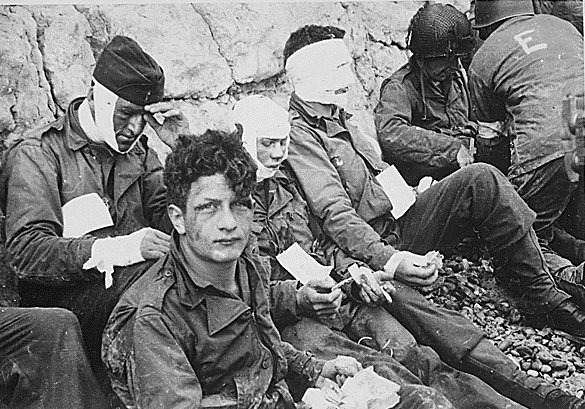
Without a doubt, my main motivation for taking this trip is to learn more about the Americans who put their lives in the line and, in some cases, paid the ultimate sacrifice to preserve freedom for the people of Europe and, in extent, the United States. As I stated in my trip proposal, I hold service to our country in high esteem, and since I have never worn a uniform, I see part of my job as teaching students about the sacrifices made by Americans past and present. I hope that this trip will not only increase my knowledge, understanding, and respect for the Americans citizens who participated in Operation Overlord and World War II, but that it will lead to greater understanding and appreciation from my students as well.


Who were the soldiers that jumped into northern France, commanded the naval craft, flew through hellacious fire, and stormed the beaches? Stephen Ambrose described them as follows: “The literature they read as youngsters was antiwar, cynical, portraying patriots as suckers, slackers as heroes. None of them wanted to be part of another war. They wanted to be throwing baseballs, not hand grenades, shooting .22s at rabbits, not M-1s at other young men. But when the test came, when freedom had to be fought or abandoned, they fought. They were soldiers of democracy. They were the men of D-Day, and to them we owe our freedom.” They have been called “The Greatest Generation”, and after all of the reading I have done to lead up to the trip, I can’t think of a better title.


I will be listening to the words of these men as I travel, in the form of the oral histories from “Voices of Valor - D-Day: June 6 1944” by Douglas Brinkley and Ronald J Drez and “WWII In Their Own Words” from Topics Entertainment. Just listening to their memories on American soil is awesome, but surely hearing them speak as I walk in their footsteps will be all the more powerful.

I would love to be able to speak with some of the men who put their lives on the line that Tuesday in northern France, or those that worked leading up to the invasion or followed afterwards and liberated France. I hope to meet with some of Wisconsin’s survivors over the next few years, but unfortunately, their numbers grow thinner by the day. There are many great repositories online of interviews with D-Day veterans, with the best being the Veterans History Project. As you read or hear these oral histories (from WWII or any other American military conflict), the most compelling part of their reflections, to me, is not the amazing feats of heroism or harrowing situations they share or comments on brotherhood and patriotism they state. While those memories always move me, I am more impressed and affected by their modesty, their humility, their resistance to call attention to their own valor and instead transfer the valor to their comrades, many of whom never made it back home. They gave the ultimate, put it all on the line, to do the right thing, and asked for nothing in return – isn’t that the definition of a hero?

Eisenhower said so when he revisited Normandy 20 years after the invasion, as he reflected "it's a wonderful thing to remember what those fellows twenty years ago were fighting for and sacrificing for, what they did to preserve our way of life. Not to conquer any territory, not for any ambitions of our own ... they did it so the world could be free."